The One-Origin Story of a Custom
The one-origin story of a custom can erase shared influences. Learn how to describe its history carefully when evidence points to several routes.
The one-origin story of a custom can make a tangled history sound settled. A greeting, festival practice, or household ritual may resemble customs in several places because people adapted it along more than one route. To describe its past fairly, match your wording to the evidence you actually have.
What does an origin claim actually say?
Calling a custom “from” one place can mean several different things. You might mean that a practice is documented there earlier than elsewhere, that a particular community shaped its familiar form, or that a custom spread outward from that place. Those are distinct claims, and evidence for one does not automatically establish the others.
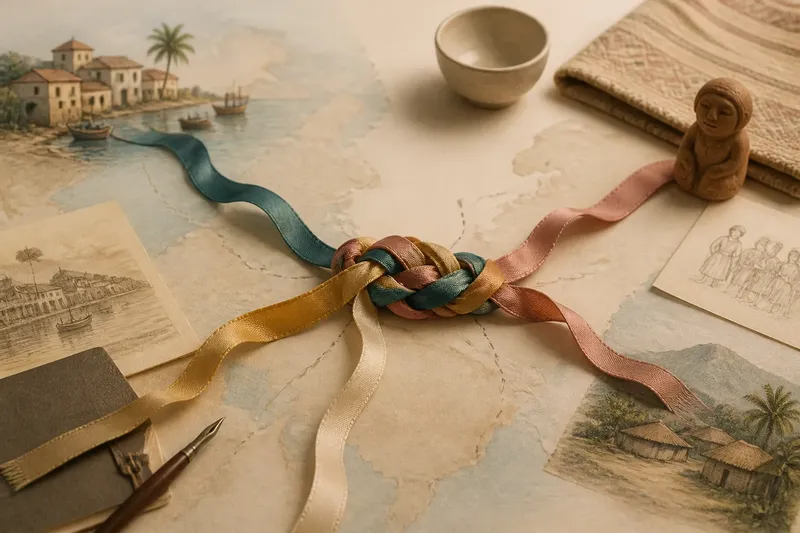
It helps to separate a custom’s components. The date of a celebration, its gestures, its objects, and the meaning people give it may have different histories. A practice that now feels like one coherent tradition can be more like a braided cord: strands meet and hold together without becoming a single strand.
So begin by asking what exactly you are tracing. If the subject is a particular gesture, do not treat evidence about the festival around it as evidence about the gesture’s birthplace. If the subject is the present-day custom as a whole, describe that form and its history without implying that every element began together.
Which description fits your evidence?
Choose the narrowest claim that remains accurate. These situations offer a practical way to decide:
- You have an early, specific record. Say the custom is documented in that place by the record’s time. This identifies an observable point in the evidence without claiming that no one practiced it earlier elsewhere.
- You can trace a recognizable route. Describe how the practice traveled, naming the communities or settings that the evidence connects. Use “spread from” only when a direction of transmission is supported, rather than inferred from resemblance.
- Several communities shaped the form now associated with the custom. Say that the practice developed through overlapping influences. This fits when distinct contributions are visible but cannot be reduced to one birthplace.
- Similar customs appear, but a connection is unclear. Call them parallels or related forms only if a relationship is supported; otherwise, say they resemble one another. Shared features alone do not establish who borrowed from whom.
- The record is fragmentary or disputed. State what is uncertain and identify the limit: the surviving sources do not settle where the practice began. That is more informative than filling the gap with a confident origin story.
Imagine you are writing a short museum label about a ceremonial ribbon. One archive records its use in a coastal town, while accounts from an inland community describe a similar gesture but do not explain how it arrived. You could say the ribbon custom is documented in the coastal town and that related forms appear inland, while the surviving accounts do not establish a single route. Readers learn what is known without being handed an invented connection.
How should you handle shared evidence?
When different communities preserve related forms, look for evidence that distinguishes contact from coincidence. Useful clues may include records describing an exchange, a sequence of changing forms, or local accounts of how people learned and adapted the practice. Similarity can prompt a question; it cannot answer that question by itself.
Pay attention to whose account supplies each claim. A government record may classify a practice in a way that local participants do not recognize. A family account may explain what a custom means now without settling its earliest history. These sources can each be valuable, but they answer different questions.
Also keep the scale of a claim visible. “This version took shape in a port community” is narrower than “the custom began in that community.” The first can acknowledge the particular form being discussed; the second can imply that all related forms descend from it. Precision often comes from naming the version, place, and kind of evidence.
What wording fits common research questions?
Can two communities develop similar customs independently?
Yes. People facing similar needs or using similar materials can arrive at comparable practices without direct contact. Similarity alone is not enough to assign a common source.
Does the oldest surviving record identify the birthplace?
It identifies an early documented appearance, not necessarily the first use. Records survive unevenly, so describe what the source establishes rather than treating its date as a starting point for everyone.
How can I mention several influences without making a list?
Describe the change: for example, say that communities adapted a shared practice to local settings and that its present form reflects those encounters. Name particular contributions only when you can explain what each one contributed.
When should I call an origin uncertain?
Use that wording when the available evidence cannot distinguish among plausible routes or beginnings. Then state what is known, such as where a form is documented or how participants describe it, so uncertainty does not become vagueness.
How can you revise a too-neat origin sentence?
Look for verbs that quietly turn evidence into certainty: “invented,” “started,” “came from,” and “spread” all carry different implications. Replace them with a verb that matches the record. “Recorded in” marks documentation; “adapted by” identifies change; “associated with” reports a present link without asserting a birthplace.
Then check whether the sentence has collapsed distinct forms into one. If a practice differs by region or community, name the version under discussion. If a source covers only one feature, do not let the sentence claim a history for the entire custom.
For an article, exhibit, or classroom discussion, the one-origin story of a custom is often less useful than a clear account of what people can establish. State the documented place or form, describe supported connections, and leave open what the record cannot resolve. That wording gives readers a sturdy account they can revisit as new evidence clarifies the custom’s many strands.