How Souvenirs Become Personal Keepsakes
Learn how a travel souvenir can become a personal keepsake, and record its place, maker, and memory without confusing private meaning with cultural context.
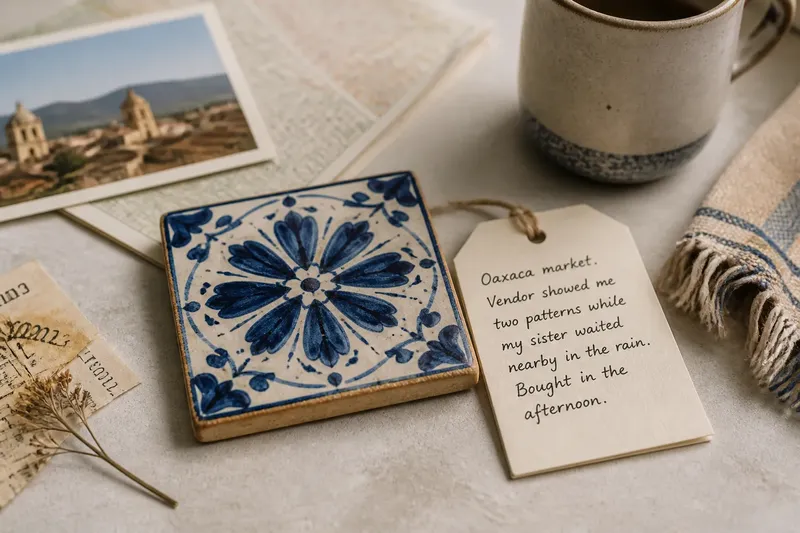
A market tile can identify a place and still mean little until you remember the conversation that led you to choose it. A travel souvenir becomes a personal keepsake when its connection to a journey gathers a specific memory, though the two meanings can remain side by side.
This is a way to interpret an object, not a claim about a single historical change. A souvenir may point outward to a destination, a maker, or a local design; a keepsake may also point inward to a person or moment. One object can do both.
What does a souvenir communicate?
A souvenir is an object kept as a reminder of a place or journey. It might be a printed postcard, a locally made cup, a ticket, or a small token. Its connection to travel makes it recognizable: someone can see it and understand that it represents somewhere beyond home.
That public association does not tell the whole story. An object’s source may be known from a shop label or maker’s mark, while its importance to the owner may come from how it was chosen or who was there. Treat those as separate kinds of information.
How does a souvenir become a keepsake?
A keepsake holds a personal association. The association can come from the object itself, but it often comes from a remembered event: a companion’s joke, a pause in the rain, or the care involved in choosing a gift. A destination name alone may identify the trip without bringing back what mattered about it.
Say you bring home a blue tile from a market and remember only the city. You later recall that a vendor showed you two painted patterns while your sister waited nearby, and you write that detail on a note kept with the tile. The object still represents the place, but the note connects it to a particular encounter; if you are unsure which stall sold it, record that uncertainty rather than naming one.
Why can souvenirs feel interchangeable?
Objects made for visitors often use familiar symbols, repeated motifs, or prominent place names so their connection is easy to read. That can be useful, but it can also make items from different trips seem alike. Look for a detail that belongs to your experience, such as the material, a maker’s mark, or the circumstances in which you found the object.
The distinction is like a labeled envelope and the letter inside it. The label tells you where it belongs; the letter holds a particular message. A souvenir’s place association can be the label, while a keepsake’s private memory is closer to the contents.
How can you record an object without overstating its story?
Write down what you know about the object’s source separately from what it means to you. A record might say, “Bought at a craft stall in Oaxaca; reminds me of the afternoon my sister and I got lost.” The first part describes a reported source; the second describes a personal memory.
- If a shop label names a maker, record the name as printed; if the label is absent, leave the maker unidentified or seek reliable information before naming one.
- If you remember the town where you bought the object, write that town; if you remember only the region, record the broader place rather than guessing a town.
- If the object has a visible mark or inscription, describe what you can see; if its meaning is unclear, call it an unidentified mark instead of assigning a cultural meaning.
- If another person shared the moment, ask whether they recall it too; if their memory differs, keep both accounts distinct rather than forcing one version.
- If you remember why you chose the object, note that reason; if you do not, state that the reason is uncertain rather than inventing one.
- If the object’s origin and your memory are both known, put them in separate sentences; if one part is unclear, mark that part as uncertain while preserving the other.
These distinctions matter because an object can carry a maker’s design or local use that is not explained by a buyer’s private story. Personal meaning does not erase the object’s source, and a source label does not explain everything the object means to its owner.
What should you ask before keeping a souvenir?
Does a souvenir have to come from the place it represents?
No. A postcard bought later or a photograph taken during the trip can recall a place without being made there. Describe where the item actually came from, then note what it represents to you.
Can an ordinary object become a keepsake?
Yes. A bus card or paper wrapper may recall a specific moment, even if it does not communicate that memory to anyone else. A short note can preserve the context the object cannot show on its own.
Should a keepsake always be displayed?
No. A visible shelf suits some reminders, while a fragile or private object may be better stored with its note. Choose a place that fits the object and its role rather than treating display as proof of importance.
What if you no longer remember why you kept an object?
Start with what you can observe, such as writing on the object, its storage place, or what you remember about receiving it. If the story remains unclear, preserve the uncertainty in a note, ask someone who shared the experience, or let the object go if you no longer want it.
When should a keepsake’s meaning change?
Memory shifts, and an object can come to represent a difficult period as readily as a happy one. A ticket stub may become clutter, or a gift may remind you of a relationship that has changed. The object has not failed; its role may simply be different now.
You can update the note, keep a photograph or written account, or decide not to retain the object. A keepsake can preserve a memory without fixing its meaning forever. When recording a travel souvenir, the main phrase is less important than the distinction it helps preserve: what is known about the object’s route, and what memory you have attached to it.